

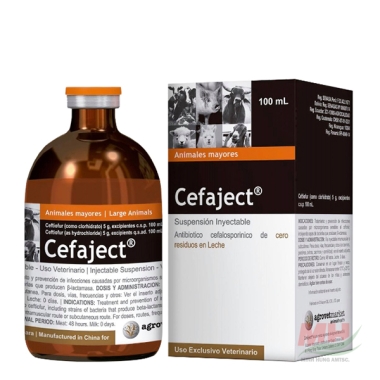
Cefaject®
-
Trang chủ
-
Giới thiệu
-
Sản phẩm
-
Dinh dưỡng - Phụ gia
-
Minh Hung AMTSC
-
Agrifirm Group
-
Premex, Mỹ
-
Innovad, Bỉ
-
Dex Ibérica, Tây Ban Nha
-
Dr Bata Ltd, Hungary
-
NEW WELL POWER Co., Ltd, Đài Loan
-
Agrochemica GmbH, Đức
-
VetPlanet d.o.o, Serbia
-
ADIQUIM S.A.S (Colombia)
-
BIŌNTE NUTRITIŌN S.L. (Spain)
-
HUNAN LERKAN BIOLOGY CO. LTD
-
Mianyang Habio Bioengineering Co., Ltd
-
Nutri service
-
SMISTYLE (NEIQIU) BIO-TECH CO., LTD.
-
Oleet Processing Ltd (Canada)
-
-
Thú y
-
Phân bón
-
Thủy sản
-
Thú cưng
-
Chế phẩm sinh học môi trường
-
Chế phẩm xử lý môi trường/ Chế phẩm hỗ trợ
-
-
Sản phẩm online
-
Kỹ thuật
-
Tin tức
-
Tuyển dụng
-
Liên hệ
-
Tài liệu


Chính sách sản phẩm
-

Chính Sách Bảo Hành
-

Chính Sách Đổi Trả
-

Chính Sách Vận Chuyển
Hỗ trợ vận chuyển các tỉnh ở xa
THÀNH PHẦN:
– Mỗi mL chứa:
+ Ceftiofur (dạng hydrochloride) 50 mg
+ Tá dược vừa đủ 1 mL
MÔ TẢ:
– Cefaject® là một công thức vô trùng sẵn sàng để sử dụng, có chứa ceftiofur (dưới dạng hydrochloride), là kháng sinh beta-lactam cephalosporin thế hệ thứ ba và có phổ kháng khuẩn rộng; hoạt động chống lại vi khuẩn Gram dương và Gram âm, bao gồm cả các chủng vi khuẩn sản xuất beta-lactamase (penicillinase). Giống như các cephalosporin khác, ceftiofur có tác dụng diệt khuẩn, ức chế sự tổng hợp của vách vi khuẩn.
– Cephalosporin là những loại thuốc có cấu trúc tương tự như penicillin, cấu trúc cơ bản gồm nhân cephem, sự hợp nhất của vòng dihydrothiazine (thay vì vòng thiazolidine điển hình của penicillin) và vòng lactam. Sự thay đổi của các chuỗi bên tạo ra các cephalosporin khác nhau, bao gồm ceftiofur.
– Ceftiofur được hấp thu nhanh chóng từ vị trí tiêm. Nồng độ trị liệu đạt được trong vài phút và nồng độ cao nhất trong huyết tương đạt được trong vòng chưa đầy một giờ. Nồng độ của nó tại vị trí nhiễm trùng cao, vì 90% thuốc liên kết với các mô và protein huyết tương. Nó hoạt động chính trong dịch ngoại bào của phổi. Ngoài ra, nghiên cứu gần đây chứng minh rằng các chất chuyển hóa có hoạt tính của ceftiofur tập trung trong các mô và chất lỏng tử cung.
– Nó được chuyển hóa nhanh chóng thành chất chuyển hóa có hoạt tính chính là desfuroylceftiofur (DFC) và axit furoic. DFC liên kết với protein huyết tương (chủ yếu là albumin và alpha – antitrypsin), đây là liên kết thuận nghịch và được lấy tên là liên kết DFC / protein. Thuốc tuần hoàn trong dưới các liên kết này chiếm 90% và 10% không liên kết với DFC. Khi các protein của vị trí nhiễm trùng tập trung, thuốc sẽ được giải phóng. Liên kết protein cung cấp sự vận chuyển tăng cường đến vị trí nhiễm trùng và thời gian bán hủy trong huyết tương dài hơn.
– Bài tiết qua nước tiểu (55% trong 24 giờ đầu) và qua phân (30% trong 24 giờ đầu). Các chất chuyển hóa khác nhau được tạo ra trong nước tiểu, các chất liên kết chính (87%) DFC acetamide.
CHỈ ĐỊNH:
Được chỉ định ở gia súc, heo, cừu, dê và lạc đà, trong tất cả các quá trình lây nhiễm do vi trùng nhạy cảm với ceftiofur gây ra, bao gồm cả các chủng vi khuẩn sản xuất beta-lactamase.
Gia súc:
– Điều trị và kiểm soát bệnh đường hô hấp ở bò (BRD: sốt do vận chuyển, viêm phổi do vi khuẩn) do Mannheimia (Pasteurella haemolytica, Pasteurella multocida và Haemophilussomnus) gây ra.
– Bệnh nhiễm khuẩn fusiformis necrophorus cấp tính ở bò (bệnh ghẻ chân, thối chân và viêm da chân) liên quan đến Fusobacterium mortrophorum và Bacteroides melaninogenicus.
– Bê tiêu chảy.
– Nhiễm trùng tuyến vú: viêm vú cấp và mãn tính: Actinomyces pyogenes, Staphylococcusaureus, Streptococcus agalactiae, Streptococcus dysgalactiae, Streptococcus uberis vàStreptococcus bovis.
– Nhiễm trùng mắt: Đau mắt đỏ: Moraxella bovis.
– Nhiễm trùng đường sinh dục: sốt hậu sản, viêm tử cung cấp tính trong khoảng từ 0-14 ngày sau khi sinh, và mãn tính liên quan đến Arcanobacterium pyogenes, đơn lẻ hoặc kết hợp với: Fusobacterium mortrophorum và Bacteroides spp; Actinobacillus (Haemophilus) pleuropneumoniae, P. multocida, Salmonella choleraesuis và Escherichia coli.
– Các bệnh do Clostridial: Clostridium chauvoei, C.osystem, C. novyi, C. perfringens, C. sordellii, C. botulinum, C. haemolyticum.
Heo:
– Điều trị và kiểm soát các bệnh đường hô hấp ở heo (viêm phổi do vi khuẩn ở heo) liên quan đến Actinobacillus (Haemophilus) pleuropneumoniae, Pasteurella multocida, Salmonella choleraesuis, Haemophilus parasuis, Streptococcus suis và Streptococcus suis loại II.
– Nhiễm trùng khớp: nhiễm trùng huyết, viêm đa khớp, viêm đa thanh dịch. Streptococcus suis và Haemophilus parasuis.
– Nhiễm trùng tử cung: hội chứng MMA (viêm vú, viêm tử cung và tuyến vú), Streptococcussuis, Streptococcus spp. và Escherichia coli.
Cừu, dê và lạc đà:
– Điều trị các bệnh nhiễm trùng đường hô hấp (viêm phổi) do Mannheimia (Pasteurella) haemolytica, Pasteurella multocida, Proteus mirabilis.
Vi trùng nhạy cảm:
– Gram âm:
Pasteurella haemolytica (Mannheimia spp.), Pasteurella multocida, Haemophilus somnus, Fusobacterium mortrophorum, Bacteroides fragilis group, Bacteroides spp. (nhóm nofragilis), Actinobacillus (Haemophilus) pleuropneumoniae, Moraxella bovis, Salmonella spp., Haemophilus parasuis, Actinobacillus suis, Arcanobacterium pyogenes, Escherichia coli.
– Gram dương:
Staphylococcus hyicus, Streptococcus suis, Peptostreptococcus anaerobes, Streptococcus spp. Beta-hemolytic.
HƯỚNG DẪN SỬ DỤNG VÀ LIỀU DÙNG:
– Đường tiêm bắp sâu hoặc dưới da.
Gia súc:
Tiêm bắp với liều 1 – 2,2 mL trên 50 kg thể trọng (1 – 2,2 mg ceftiofur cho mỗi kg thể trọng). Việc điều trị nên được lặp lại trong khoảng thời gian 24 giờ trong 3 ngày liên tục (tối đa 5 ngày trong trường hợp viêm tử cung).
Heo:
Tiêm bắp với liều 0,6 -1 mL cho mỗi 10 kg trọng lượng cơ thể (3 – 5 mg ceftiofur cho mỗi kg trọng lượng). Việc điều trị phải được lặp lại mỗi 24 giờ trong 3 ngày liên tục (tối đa 5 ngày trong trường hợp viêm tử cung).
Cừu, dê và lạc đà:
Tiêm bắp với liều 0,22 – 0,44 mL (1,1 – 2,2 mg Ceftiofur) trên 10 kg thể trọng mỗi 24 giờ trong 3 ngày liên tiếp. Việc điều trị thêm nên được lặp lại từ 4 đến 5 ngày đối với những con vật không có phản ứng tốt
QUY CÁCH: Chai 100 ml
Sản phẩm cùng loại














Địa Chỉ: Tầng 14, Tòa nhà HM Town, 412 Nguyễn Thị Minh Khai, P Bàn Cờ, TP Hồ Chí Minh,
Hotline: 02862.539.776
Tuyển Dụng: 0903 165 395
Email: cs01minhhung@gmail.com
Website: https://minhhungagri.com.vn/


Chính sách hỗ trợ
Đăng ký nhận tin
Liên kết nhanh
Hệ thống phân phối
Hệ thống kinh doanh
Tin tức
Giá heo hơi hôm nay 7/11/2023: Tăng giảm 1.000 - 2.000 đ/kg
Giá heo hơi hôm nay 6/11: Từ 50.000 đồng/kg đến 54.000 đồng/kg
Giá heo hơi hôm nay 24/10: Tăng tại nhiều địa phương trên cả nước
Hội thảo "Giải pháp toàn diện cho gia cầm khỏe mạnh mau lớn - Úm gà đạt hiệu quả cao" - Gò Công Tây, Tiền Giang
Hội thảo tại Lâm Đồng tháng 07/2023
Tuyển dụng
Nhân Viên Sales Thủy Sản
Nhân Viên Sales Online
Nhân Viên Sales Phân Bón
Nhân Viên Sales Thuốc Thú Y
Nhân Viên Lab Kỹ Thuật Thị Trường
Nhân Viên Kỹ Thuật Tôm
Nhân Viên Kỹ Thuật Phân Bón
2023 Copyright © Minh Hưng AMTSC. Designed by Nina.vn

