

Medium Chain Fatty Acid là gì?
Trong bối cảnh ngành chăn nuôi toàn cầu đang đối mặt với áp lực giảm sử dụng kháng sinh, kiểm soát dịch bệnh và nâng cao hiệu quả sản xuất, Medium Chain Fatty Acid (MCFA - axit béo chuỗi trung bình) nổi lên như một giải pháp dinh dưỡng sinh học có khả năng hỗ trợ kiểm soát nhiều loại vi khuẩn và virus quan trọng trên heo, gia cầm và thủy sản.
MCFA bao gồm các acid béo có chiều dài chuỗi carbon từ C6 đến C12, phổ biến nhất gồm:
- Caproic acid (C6)
- Caprylic acid (C8)
- Capric acid (C10)
- Lauric acid (C12)
Nhờ đặc tính kháng khuẩn, kháng virus và hỗ trợ sức khỏe đường ruột, MCFA đang trở thành thành phần quan trọng trong các chương trình an toàn sinh học và dinh dưỡng chức năng của các trang trại hiện đại.
Vì sao ngành chăn nuôi hiện đại cần giải pháp thay thế kháng sinh?
Các thách thức hiện nay bao gồm:
- Sự gia tăng hiện tượng kháng kháng sinh.
- Áp lực từ thị trường xuất khẩu yêu cầu giảm tồn dư kháng sinh.
- Virus ngày càng biến đổi và khó kiểm soát.
- Chi phí điều trị tăng cao trong khi hiệu quả điều trị giảm.
- Nhu cầu nâng cao miễn dịch tự nhiên của vật nuôi.
Do đó, xu hướng hiện nay không còn là "điều trị khi bệnh xuất hiện" mà chuyển sang chiến lược:
Ngăn chặn mầm bệnh xâm nhập – giảm tải mầm bệnh – tăng sức đề kháng vật nuôi.
MCFA chính là một trong những công cụ quan trọng của chiến lược này.
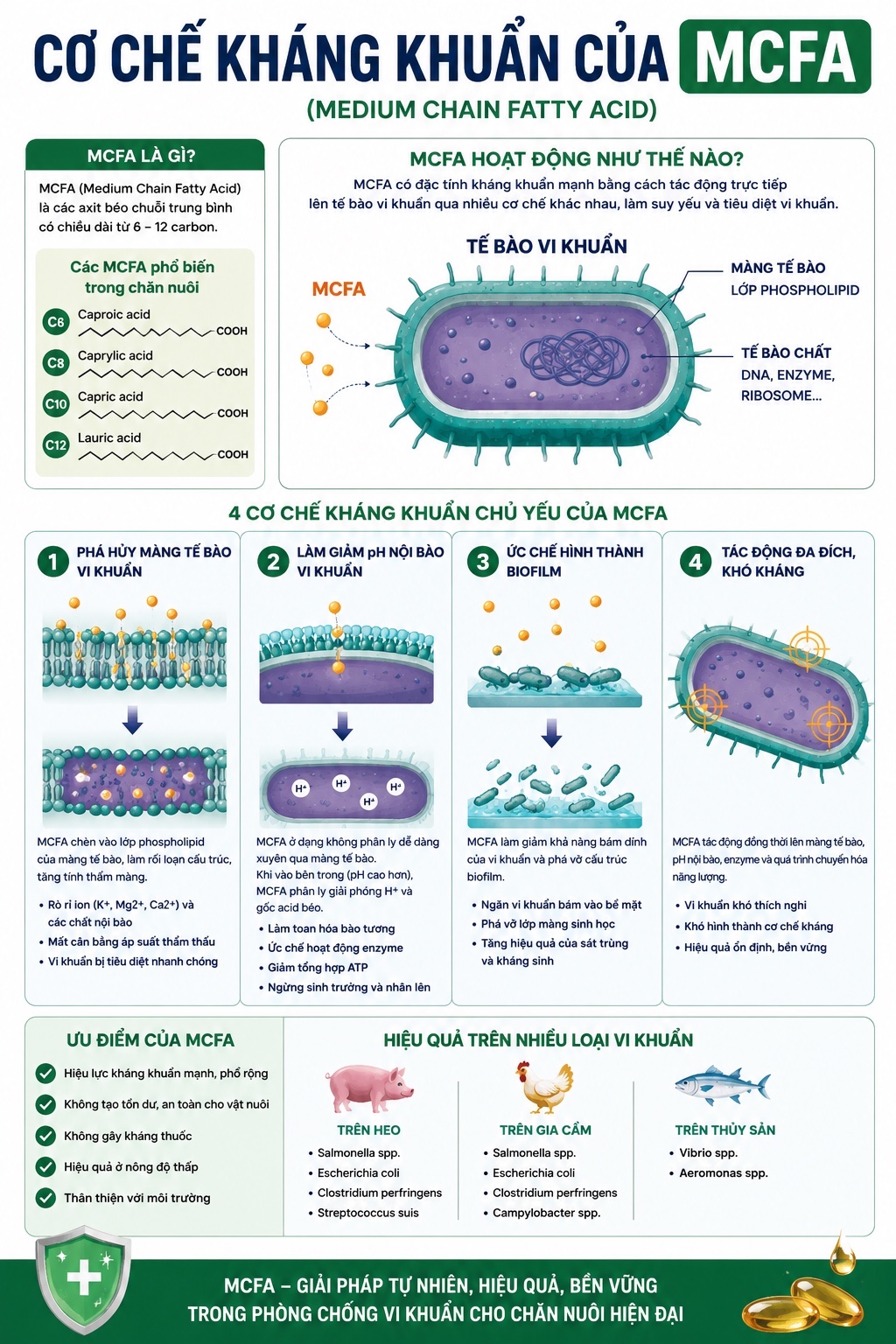
Cơ chế kháng khuẩn của Medium Chain Fatty Acid
1. Phá hủy màng tế bào vi khuẩn
MCFA có tính ưa lipid cao, cho phép chúng chèn trực tiếp vào lớp phospholipid của màng tế bào vi khuẩn.
Kết quả:
- Tăng tính thấm màng tế bào.
- Rò rỉ ion và protein nội bào.
- Mất cân bằng áp suất thẩm thấu.
- Vi khuẩn chết nhanh chóng.
Cơ chế này đặc biệt hiệu quả với:
- Vi khuẩn Gram dương.
- Một số vi khuẩn Gram âm có lớp màng ngoài mỏng hơn.
2. Làm giảm pH nội bào vi khuẩn
MCFA ở dạng không phân ly dễ dàng đi xuyên qua màng vi khuẩn.
Khi vào môi trường nội bào có pH cao hơn, chúng phân ly tạo ra:
- Ion H+
- Gốc acid béo
Điều này gây:
- Toan hóa bào tương.
- Rối loạn enzyme chuyển hóa.
- Giảm tổng hợp ATP.
- Ngừng sinh trưởng và nhân lên.
3. Ức chế hình thành biofilm
Biofilm là lớp màng sinh học giúp vi khuẩn:
- Tránh được tác động của kháng sinh.
- Tăng khả năng tồn tại trong hệ thống nước uống.
- Tăng khả năng tái nhiễm đàn.
MCFA giúp:
- Giảm khả năng bám dính của vi khuẩn.
- Phá vỡ cấu trúc biofilm.
- Tăng hiệu quả của chương trình sát trùng và kháng sinh.
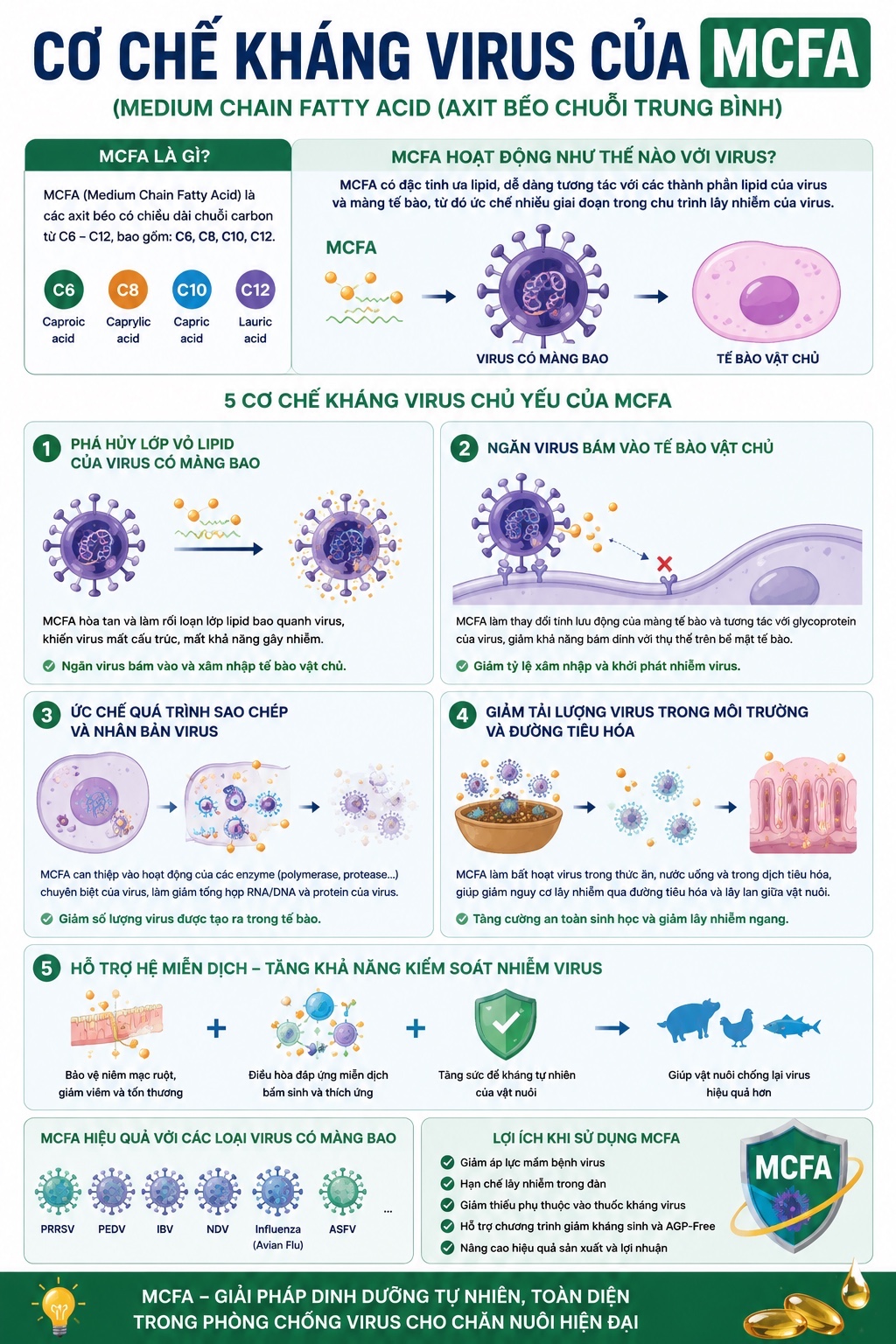
Cơ chế kháng virus của MCFA
1. Phá hủy lớp vỏ lipid của virus có màng bao
Nhiều virus gây thiệt hại lớn trong chăn nuôi có cấu trúc màng lipid bao quanh.
MCFA có khả năng:
- Hòa tan lớp lipid này.
- Làm virus mất khả năng bám vào tế bào vật chủ.
- Ngăn cản quá trình xâm nhập và nhân lên.
2. Ức chế quá trình sao chép virus
Một số nghiên cứu cho thấy MCFA có khả năng:
- Làm giảm hoạt tính enzyme cần thiết cho quá trình nhân bản virus.
- Giảm số lượng virus được tạo ra.
- Hỗ trợ hệ miễn dịch kiểm soát nhiễm trùng hiệu quả hơn.
3. Giảm tải lượng virus trong thức ăn và đường tiêu hóa
Thức ăn hiện được xem là một trong những con đường truyền bệnh quan trọng.
MCFA khi bổ sung vào thức ăn có thể:
- Giảm tải lượng virus trong nguyên liệu.
- Giảm nguy cơ lây truyền ngang.
- Tăng mức độ an toàn sinh học của trang trại.
Những loại virus có thể được hỗ trợ kiểm soát bởi MCFA
Trên heo
- PRRS.
- PED.
- TGE.
- ASFV.
- Circovirus (PCV2).
Trên gia cầm
- Newcastle Disease.
- Infectious Bronchitis.
- Avian Influenza.
- Gumboro.
Trên thủy sản
- WSSV.
- IMNV.
- TSV.
Lưu ý rằng MCFA không phải là thuốc điều trị virus mà đóng vai trò quan trọng trong chiến lược giảm áp lực mầm bệnh và hỗ trợ miễn dịch.
CÁC VI KHUẨN THƯỜNG NHẠY CẢM VỚI MCFA
Trên heo
- Salmonella spp.
- Escherichia coli.
- Clostridium perfringens.
- Streptococcus suis.
Trên gia cầm
- Salmonella spp.
- E. coli.
- Clostridium perfringens.
- Campylobacter spp.
Trên thủy sản
- Vibrio spp.
- Aeromonas spp.
MCFA giúp cải thiện sức khỏe đường ruột như thế nào?
Ngoài tác dụng kháng khuẩn trực tiếp, MCFA còn giúp:
Tăng chiều cao nhung mao ruột
- Tăng diện tích hấp thu dưỡng chất.
- Cải thiện FCR.
Giảm viêm ruột mãn tính
- Giảm stress oxy hóa.
- Giảm tổn thương biểu mô ruột.
Hỗ trợ hệ vi sinh vật có lợi
- Tạo điều kiện cho Lactobacillus phát triển.
- Giảm sự cạnh tranh của vi khuẩn gây bệnh.
VAI TRÒ CỦA MCFA TRONG CHƯƠNG TRÌNH GIẢM KHÁNG SINH
MCFA được xem là một trong những trụ cột của chương trình:
AGP-Free Production
Giúp:
- Giảm sử dụng kháng sinh kích thích sinh trưởng.
- Duy trì năng suất.
- Đảm bảo an toàn thực phẩm.
Quản lý kháng sinh
MCFA hỗ trợ:
- Giảm số lần sử dụng kháng sinh điều trị.
- Giảm áp lực chọn lọc vi khuẩn kháng thuốc.
- Tăng hiệu quả điều trị khi cần sử dụng kháng sinh.
Hiệu quả kinh tế của việc sử dụng MCFA
Các lợi ích kinh tế thường được ghi nhận bao gồm:
✓ Giảm tỷ lệ tiêu chảy sau cai sữa.
✓ Giảm tỷ lệ chết do bệnh đường ruột.
✓ Cải thiện tăng trọng trung bình ngày.
✓ Cải thiện hệ số chuyển đổi thức ăn (FCR).
✓ Giảm chi phí thuốc điều trị.
✓ Tăng đồng đều đàn.
✓ Tăng lợi nhuận trên mỗi con xuất bán.
Khi nào nên sử dụng MCFA?
MCFA đặc biệt phù hợp trong các giai đoạn:
Đối với heo
- Heo cai sữa.
- Giai đoạn chuyển chuồng.
- Thời điểm nguy cơ PRRS hoặc PED cao.
- Trại có lịch sử tiêu chảy kéo dài.
Đối với gia cầm
- Giai đoạn úm.
- Sau vaccine sống.
- Khi thay đổi thời tiết.
- Giai đoạn nguy cơ viêm ruột hoại tử.
Đối với thủy sản
- Thời điểm giao mùa.
- Giai đoạn mật độ nuôi cao.
- Khi chất lượng nước biến động.
XU HƯỚNG TƯƠNG LAI: MCFA TRỞ THÀNH THÀNH PHẦN CỐT LÕI CỦA AN TOÀN SINH HỌC DINH DƯỠNG
Trong tương lai gần, các chương trình kiểm soát dịch bệnh sẽ không chỉ dựa vào vaccine và thuốc điều trị mà sẽ dựa trên ba trụ cột:
- An toàn sinh học trang trại.
- Dinh dưỡng chức năng.
- Quản lý miễn dịch chủ động.
MCFA là cầu nối giữa dinh dưỡng và an toàn sinh học, giúp giảm áp lực mầm bệnh ngay từ thức ăn và đường tiêu hóa trước khi bệnh xuất hiện trên đàn.
KẾT LUẬN
Medium Chain Fatty Acid không đơn thuần là một phụ gia thức ăn mà đang trở thành giải pháp chiến lược trong chăn nuôi hiện đại.
Với khả năng:
- Hỗ trợ kiểm soát virus có màng bao.
- Ức chế vi khuẩn gây bệnh.
- Cải thiện sức khỏe đường ruột.
- Giảm phụ thuộc vào kháng sinh.
- Nâng cao hiệu quả kinh tế trang trại.
MCFA đang đóng vai trò quan trọng trong mô hình chăn nuôi bền vững, an toàn sinh học cao và đáp ứng yêu cầu của thị trường toàn cầu về sản phẩm chăn nuôi sạch, an toàn và hiệu quả.